Velys robotic knee replacement in Visakhapatnam
Dr Ravi Chandra Vattipalli provides surgeon-led robotic knee replacement at Care Hospitals, Visakhapatnam.
A robotic-assistance tool and a surgeon-led plan
Velys is a robotic-assistance system used during total knee replacement. The system supports planning and bone preparation. It does not operate independently: the surgical team uses real-time planning and feedback to individualise bone cuts and assess soft-tissue balance, and the surgeon remains responsible for examination, clinical decisions, implant choice, safety and the operation.
Every recommendation follows an examination, an imaging review and a discussion of non-surgical, conventional and robotic options. Robotic assistance is not suitable for every patient.
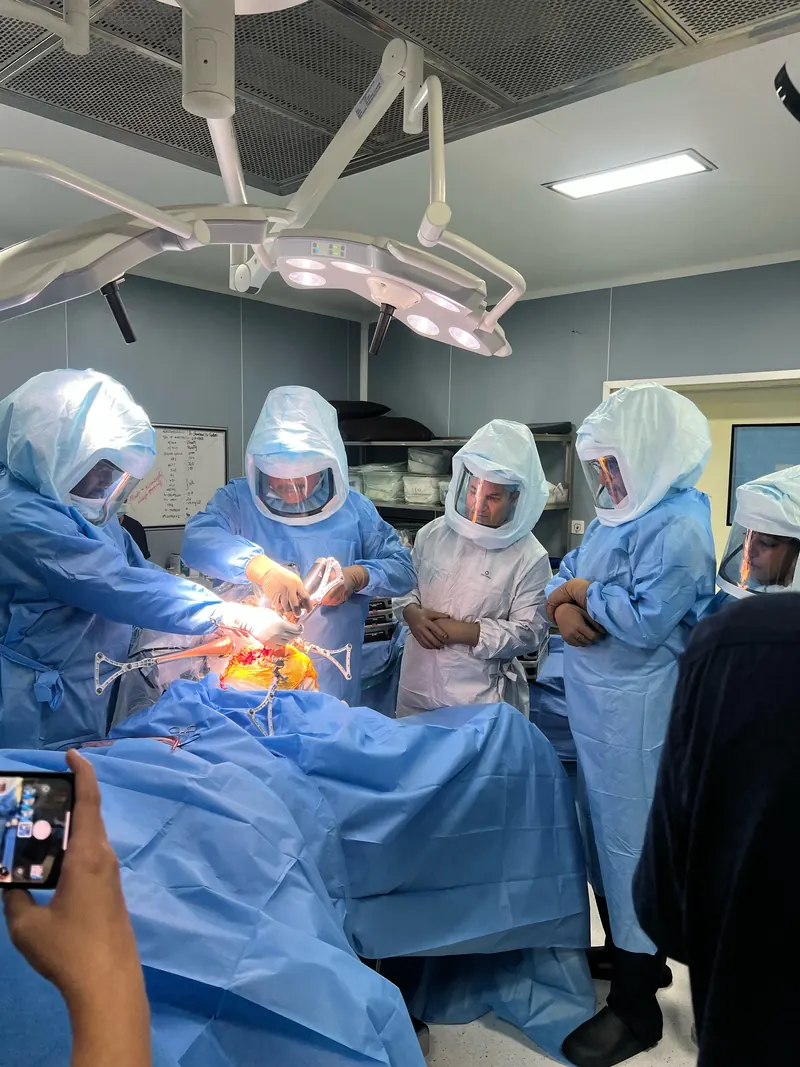
Experience and context
The practice figure is 661+ robotic knees. That is experience context. It is not a success rate and not a prediction for an individual patient.
Dr Ravi Chandra Vattipalli also teaches and proctors Velys courses. See the faculty record and publications.
Medial Stabilised knee design with Velys
The Hindu reported in March 2026 on a Medial Stabilised (Medial Pivot) knee design combined with robotic-assisted surgery at Care Hospitals, Visakhapatnam. That report is programme context, not a promise that every patient needs or receives the same implant. Implant choice remains a clinical decision. See the news feature.
ERAS and same-day mobilisation
Enhanced Recovery After Surgery (ERAS) brings assessment, anaesthesia, pain control, physiotherapy and discharge planning together. When clinically appropriate, selected patients may stand and walk on the day of surgery. The team checks strength, comfort and safety before each step.
- Walking with support may be planned when the care team judges it safe; recovery varies.
- Patients on the last operating list may wait if the spinal anaesthetic has not fully worn off.
- Recovery plans are individual, and timing changes whenever a safety check is not met.
Possible advantages to discuss
- Real-time planning may help the team tailor bone preparation to the patient’s anatomy.
- Real-time feedback may help the surgeon assess alignment and soft-tissue balance during the operation.
- A planned ERAS pathway may give the family a clearer picture of the first walk and its safety checks.
- A surgeon-led consultation may help the patient compare operative and non-operative options.
These are possible advantages to discuss, not guarantees. Medical fitness, imaging, symptoms, anaesthesia, rehabilitation and the surgeon’s assessment determine whether knee replacement is appropriate. Individual results vary.
Risks: Knee replacement, with or without robotic assistance, carries risks including infection, blood clots, stiffness, implant wear or loosening over time and anaesthesia risks. These are discussed at consultation.
For hip questions, see DAA hip replacement (current practice) and the robotic hip roadmap (not live).
Robotic knee replacement FAQs
What is Velys robotic knee replacement?
Velys is a robotic-assisted system used during total knee replacement that helps plan and guide bone preparation. The surgeon remains in control of decisions and soft-tissue balance.
Does the robot replace the surgeon?
No. Robotic assistance is a tool. Surgical judgment, soft-tissue balance, and the final plan stay with the surgical team.
Is robotic assistance used for every total knee in this practice?
In Dr Ravi Vattipalli’s practice, Velys robotic assistance is the planned pathway for the total knee replacements he performs when clinically suitable.
How many Velys robotic knee replacements has Dr Ravi Vattipalli performed?
661+ Velys robotic knees. This is experience context, not a success rate and not a prediction for any one patient.
What is ERAS after robotic knee replacement?
Enhanced Recovery After Surgery is a structured pathway. Same-day mobilisation is a planned step with safety checks (anaesthetist clearance, a therapist and a walker), and it is delayed when it is not safe.
How does walking after surgery work?
In this ERAS pathway for robotic knee replacement, walking with support may be planned when the care team judges it safe; recovery varies. Walking is delayed when it is not safe, and it is not guaranteed for every case.
How can an appointment be booked?
Message the clinic on WhatsApp or call +91 81213 85964, or use the Book page on this website.
Disclaimer: Educational information about bone, joint and robotic knee care. It does not replace an in-person consultation with a qualified orthopaedic surgeon. Individual results vary.